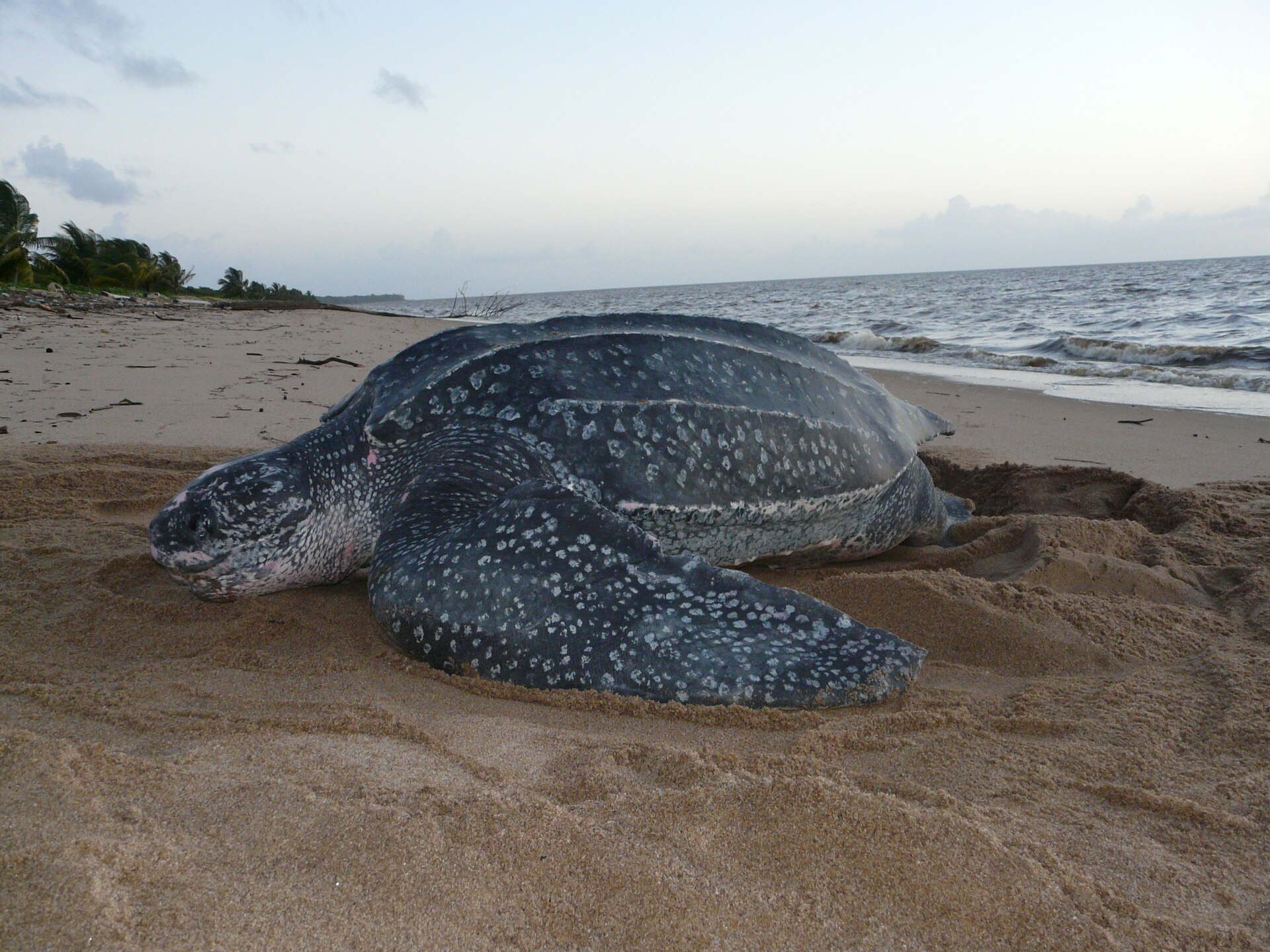
Leatherback Sea Turtle Facts Dermochelys coriacea
Leatherbacks are the world's largest turtles and the only sea turtles without a hard, scaly shell. Their flexible ridged carapace and long flippers support migrations across entire ocean basins.
- Habitat
- Marine
- Diet
- Jellyfish, salps, and other soft-bodied ocean animals
- Lifespan
- Estimated 45–50 years or more
Classification
Family: Dermochelyidae. Order: Testudines.
Leatherback Sea Turtle Habitat
Leatherback Sea Turtles live in Marine and Coastal habitats. Their recorded range includes Atlantic, Pacific, and Indian Oceans. Suitable food, shelter, and conditions for raising young help shape that range.
What Do Leatherback Sea Turtles Eat?
Diet classification: Carnivore. Recorded foods: Jellyfish, salps, and other soft-bodied ocean animals.
Leatherback Sea Turtle Lifespan, Size, and Weight
Recorded lifespan: Estimated 45–50 years or more. Recorded size: 152–183 cm. Recorded weight: 340–454 kg.
Leatherback Sea Turtle Conservation Status
Leatherback Sea Turtle is listed here as Vulnerable. Protecting habitat, maintaining healthy prey or food sources, and reducing human pressure are important parts of conserving wild populations.
Quick facts
- Region
- Atlantic, Pacific, and Indian Oceans
- Habitat
- Marine, Coastal
- Diet
- Carnivore
- Lifespan
- Estimated 45–50 years or more
- Size
- 152–183 cm
- Weight
- 340–454 kg
Fun facts
- Leatherbacks can dive to depths of about 1,200 metres.
- Backward-pointing spines in the mouth help retain slippery jellyfish prey.
- Some migrations between feeding and nesting areas span thousands of kilometres.
- Females leave the ocean to lay eggs on tropical and subtropical beaches.
Explore related categories
Discover more with the random animal generator or browse all animal profiles.
Similar animals
Explore nearby branches of the animal world.
Ready for another discovery?
The animal kingdom is full of surprises.
Sources and image credit
Animal facts are reviewed against the references below. The photograph remains available under the stated license.